
In early 2024, the teachers’ union at Columbia Heights Public Schools (CHPS), Local #710, finally voted for and had a contract approved by the school board for the 2023-2025 school years. This protracted process, which began in summer 2022, set the stage for tension and uncertainty for the next round of negotiations between CHPS administration and 710 for the 2025-2027 school years.
Contract negotiations went on from July 2025 to January of this year, meaning CHPS teachers worked without a contract for 200 days. For context, teacher contracts get reviewed and renewed in two-year increments, with leadership positions for the union shifting more than ever during this most recent round of review and renewal, not to mention the sudden reprioritization of focusing on keeping students and families safe amidst the occupation of ICE agents in the city.
Eventually, an agreement was reached and voted on by 710 membership on January 29, and then approved by the board on February 17, but in the process of reaching it, though, many in the union shared worries of what would happen if the union didn’t agree, and while it did pass, it was not unanimous, with tensions inarguably still high among teachers.
Taking over half of the school year, working without a proper contract left CHPS staff vulnerable. In addition to teachers, other employee units (education support professionals, custodial staff, food service workers and more) continued to work without contracts as well, since the teacher contract sets the stage for wage increases across other groups.
“Contracts are more complicated than just the teacher’s interests, and there are many things to consider when reaching agreements,” 710 union member and CHHS English Teacher Ms. Tina Schaefer said. “Many compromises on both the district side and the teacher’s side have to be made. I don’t think that there will ever be a ‘perfect’ teacher contract unless society decides to fully fund education and truly support what students need. This is a strong community, and I think we will continue to work together and do what is best for our students.”
These budgeting discussions have been fueled by the recent funding cuts that amount to around $45 billion toward K-12 learning, which directly affects teacher wages. Educators in Minnesota have an average starting salary of $46,526 and an overall average of $72,030 per year — at the same time making 5% less than they did 10 years ago. Although these numbers may seem pretty livable compared to, say, an hourly service-worker job, in reality, these average salaries also take college educators into account, who make far more than K-12 educators. On top of this, inflation and the cost of living have shot up significantly in recent years, putting even more strain on teachers’ wages.
“I, as a student, didn’t know that teachers were working without a new contract,” Adrian Neri Ochoa (12) said. “This is an unlivable starting wage fresh out of college at the age of 22. Teachers should be paid more as they pave the way for future generations. Cutting funds for the education department will lead the next generation to be ignorant of history and keep repeating the old cycles that we see today.”
Being undereducated can not only lead to cognitive impairment later in life, but also a lack of learned experiences. The human brain and its development of the cerebrum is a feat of nature; it is a show of high intelligence, such as the ability to recognize patterns, remember them and survive based on reasoning. The variations of written and spoken language are direct, advanced results of this phenomenon, which allow humans to extend their experiences outside of one’s personal timeframe of the lifecycle.
Early childhood education is vital to academic development, elementary education is key to social-emotional development and middle and high school education are the fundamental pathways for attaining basic and higher education. Unfortunately, the nation has been facing a widespread teacher shortage, where stagnating wages and harmful work environments make it difficult to attract highly qualified candidates. When education struggles as a system, especially in a historical context, this can cause someone to not have as many learned experiences, becoming more prone to repeating past mistakes. Humanity has surpassed the point of needing brains for basic survival, but to function under a social structure that came to fruition from complex and layered written language.
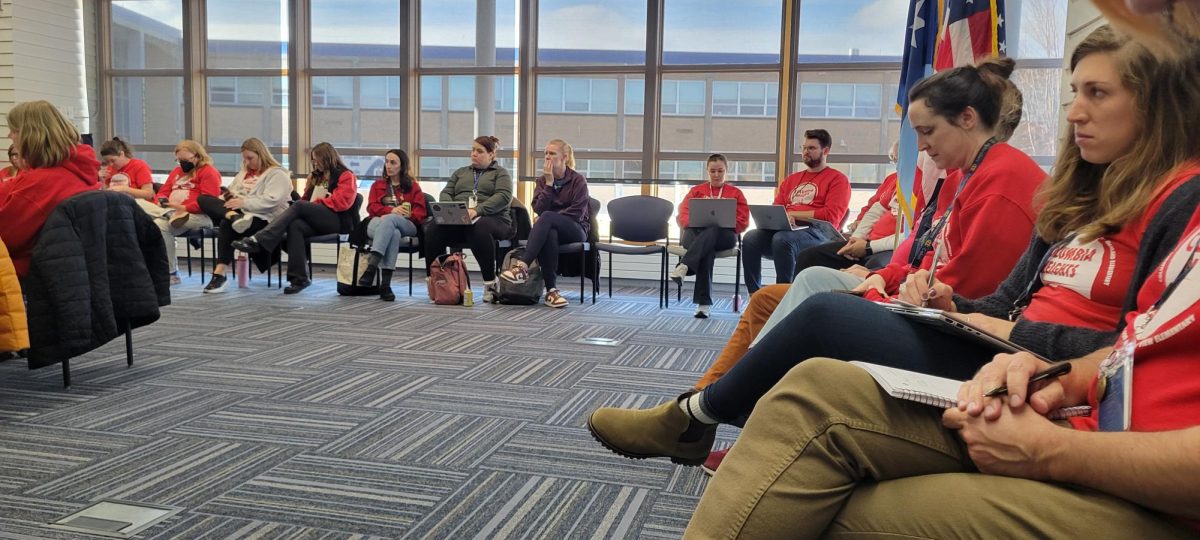
In a show of support for 710 leadership on the negotiations committee, several teachers showed up to a meeting with district administration on November 10 last year to spectate. Then, at a December performance of the musical “Newsies” at the Performing Arts Center (PAC) at Columbia Heights High School, teachers were seen handing out flyers mirroring the “Newsies” banner, or protest flyer stating the need for higher wages, reduced workload, proper sick time and protected healthcare benefits. The school board and district administration undergo a lot of pressure from budget cuts and from where they can reallocate funds, so while the need for improvements was implicitly understood, it still stoked frustrations and felt to many like two well-meaning groups found themselves pitted against each other.
The union and district administration were able to reconcile to some degree, whether due to pressures that are currently being put on public schools by the federal and state governments or simply wanting to move on and try again next round, or perhaps a combination of the two. The recent resignation of Local 710 union president and chief negotiator Mr. Daniel Honigs as well as sudden trauma in the Columbia Heights community certainly made matters more difficult too
“What I see that the future holds for Columbia Heights teachers is a long battle of equal treatment,” Neri Ochoa said (12). “Funding cuts for schools [hurt] teachers as well. How can teachers focus on what’s in front of them in a classroom full of students when they have to keep in mind realistically how they will be able to live comfortably at home?”
CHPS teachers are not the only teachers who are facing these obstacles, as many educators across the country are facing low wages. Educators are integral to our community as they are in any part of the country. In our current climate, education is needed more than ever, and so is support for educators. One way the Columbia Heights community can help support these teachers is to hear their voices and struggles. Showing support and understanding for teachers reminds them of why they joined their beloved profession in the first place.