With a recently reported swastika drawing appearing at a U.S. military training center, a certain branch of the American armed forces has elicited much discourse about what kind of imagery falls under freedom of speech protections versus what constitutes hate speech.
The fracas started when the United States Coast Guard drafted a revision to its policy language this past November surrounding the use of hate symbols. According to Coast Guard commandant, Admiral Kevin Lunday, symbols such as swastikas and nooses are no longer considered hate symbols in the eyes of the military branch in charge of search and rescue missions at sea, protecting marine ports and more.
For those unfamiliar, nooses represent the history of racially driven threatening, lynching and killing of minorites and their allies throughout the U.S. during the time of the Civil War. Swastikas are a sign used in support of the Nazi Party, including Neo-Nazis, and have been widely known for over a century for their racist rhetoric and violence. There are other symbols of hate, but none as prominent in history and now as the noose and swastika.
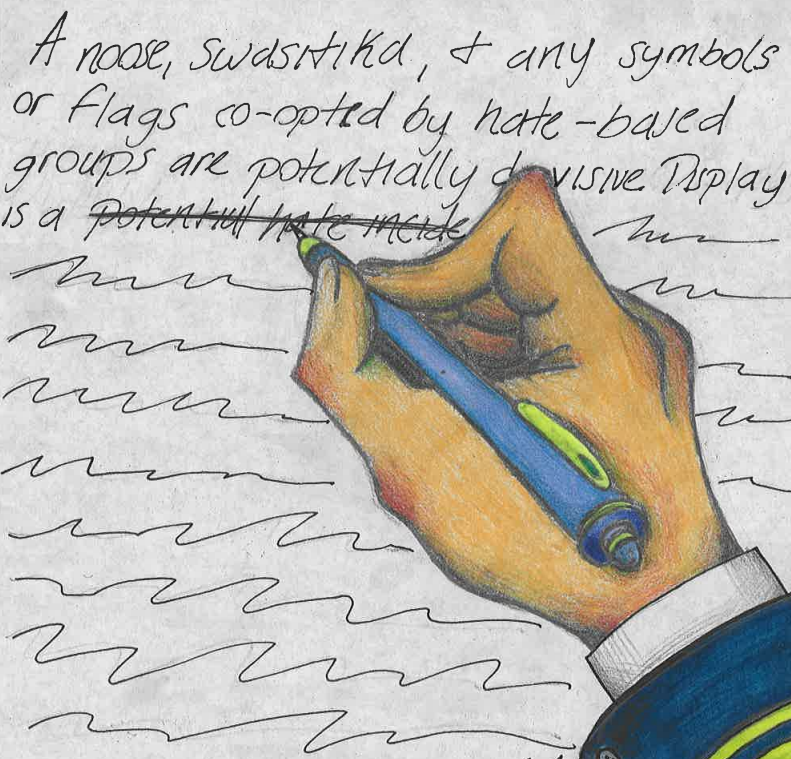
Despite these symbols’ horrible histories, the Coast Guard released a memo in late 2026 with a new policy overriding what they had previously said in their other memos, which stated displaying these symbols constitutes “a potential hate incident,” to the new phrase “potentially divisive,” meaning the imagery may tend to cause disagreement. While the language did not ultimately become the new policy, it might have if the Washington Post’s reporting during the draft stage hadn’t been published.
“I think that changing the meanings of these symbols minimizes the suffering of the people these symbols were used against,” Sam Rismoen (9) said. “When you change the meanings, it erases the history behind the symbol. I believe that this is promoting hateful actions.”
Many legislators and human rights groups have criticized the proposed change, especially since the Coast Guard is part of the Department of Homeland Security, which is supposed to protect Americans from danger and those symbols represent immense danger.
“I think that symbols matter, particularly when a branch of the military is meant to represent the views of our country,” CHHS Social Studies teacher Mrs. Jen McCloskey said. “If you allow symbols that have historically been symbols of hate to appear alongside the American flag, then it gives the appearance that this hate represents the views of our country.”
After the memo was leaked and criticism mounted in the press and on social media, the Coast Guard reverted back to their original policy of not allowing the display of these hate symbols. Creating a new policy altogether, the language wound up making it even clearer that the symbols are not allowed and displays will be treated as “potential hate incidents” if the symbols are ever displayed.
Similarly, closer to home here in Minnesota, the Forest Lake School board was also recently attempting to unban those symbols in their schools. Their initial policy was “the following are prohibited on school property or at school-sponsored events: Wearing or displaying confederate flag, swastika and KKK signs or symbols.” According to Fox 9 News, the board had proposed to unban these symbols from school premises in their district, letting the individual schools decide how they would move forward if the removal went through.
¨The ban of hate symbols helps students feel more comfortable in their learning environment,” Rismoen said. “When kids are at school, they shouldn’t have to be afraid.” Schools are supposed to be a safe place for education and growth, not another place where racism and hate symbols/speech are accepted.”